

Creating the Story Sermon

Creating the Story Sermon
In the last post we reflected on doing the background work prior to creating the story sermon. In this post we take the next step, actually creating the story sermon itself.
Releasing the Imagination
After doing the exegetical work, it’s time to turn on the creativity. Spend some time imagining the character you are choosing to present in your story sermon. You can likely find images online of what people think they looked like, but you are more interested in what they felt like. In the scene you wish to recreate, what were they thinking? What were they feeling? How do those feelings relate to the message you want to bring to your people by creating the story sermon that you are working on?
When I created a story sermon with King Herod as the character, I spent some time reflecting on what we know about him from the Scriptures and from history. Here are some of the things I learned.
His background
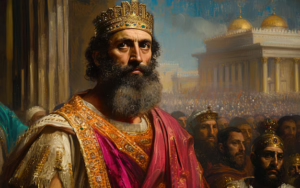 Herod was born around 73 BC. He was not ethnically Jewish in the traditional sense. His father, Antipater, was an Idumean (Edomite), and his mother, Cypros, was Nabatean. His family had converted to Judaism a generation or two earlier.
With Roman support, Herod was declared “King of the Jews” by the Roman Senate in 40 BC, although he didn’t fully secure his kingdom until 37 BC after defeating his rivals.
He ruled under Roman authority but had considerable independence in governing Judea.
Herod was an extraordinary builder.
His major projects included:
- Rebuilding and vastly enlarging the Second Temple in Jerusalem (the Temple Jesus later visited)
- Constructing the port city of Caesarea Maritima
- Building the fortress-palaces of Masada and Herodium
- Renovating fortresses throughout Judea
- Constructing theaters, amphitheaters, and aqueducts
The Temple renovation was so magnificent that even Jesus’ disciples admired it (Mark 13:1).
Ancient sources consistently portray Herod as brilliant, politically skilled, and increasingly paranoid.
Josephus records that he:
- Executed his wife Mariamne, whom he reportedly loved deeply.
- Killed three of his own sons because he suspected they were plotting against him.
- Executed numerous political opponents.
- Constantly feared conspiracies.
The Roman emperor Augustus is said to have joked:
“It is safer to be Herod’s pig than Herod’s son.”\
The Choices
After you know as much about your character as possible, it’s time to think through what emphasis you want to create in your story sermon. I chose to tell his story through him. I especially emphasized his jealousy, a jealousy and paranoia that led to the slaughter of the children as recorded in Scripture.
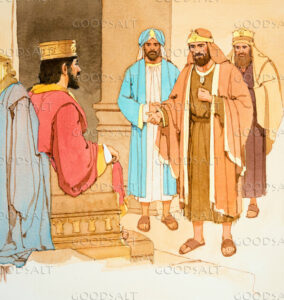 I decided that I wanted to give the first person message the flavor of wonder at how God planned the birth of Jesus, and then protected the baby from the machinations of this jealous, paranoid ruler. So, the character I created simply was telling the story of his life to the audience. When it came to the arrival of the Magi seeking the Jewish king, I described how people were always plotting against me. They wanted my throne, etc. So, I set the trap. “When you’ve found him, tell me where he is so that I, too, can go and worship.”
For that message, I chose to dress the part as well.
The Writing
I do suggest that you write out the message, even if that is not your normal approach. The reason is that you can play with the words. And remember, you need descriptive words, drawing pictures for your hearers. You are creating the story sermon. It has to be like a story you would tell to your children.
The Practice
Know this: you will need to practice this message more than your typical kind. It does help if you’ve got a bit of the actor in you as you prepare.

